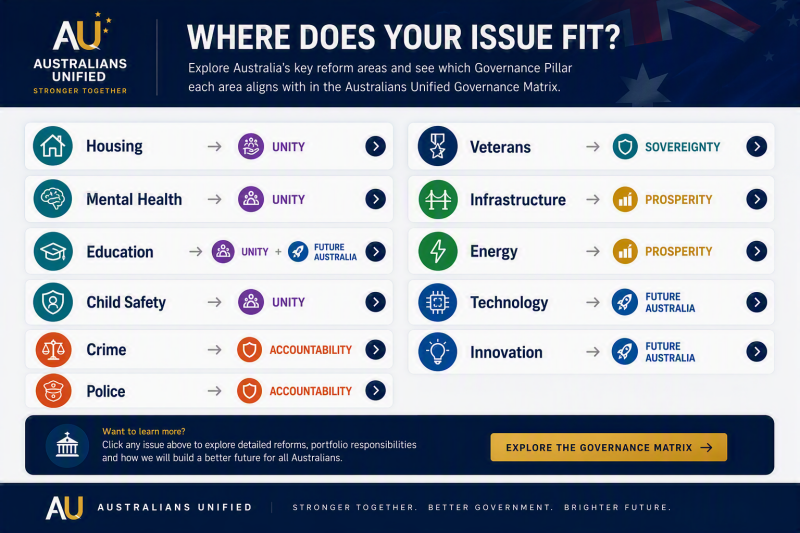
A national unified movement of understanding in restoring control over our resources, borders, infrastructure and future.

Uniting Australians For A Future

We have created a website designed to help Australians understand the key structure, policies, principles, and moral values needed to understand & improve our Countries, ideologies, policies and governmental systems. The platform explains our current position and the major areas where change is required and outlines the problem, corrective actions to policy, the reforms and structural adjustments necessary to strengthen Australia’s future. Our goal is to make these issues accessible, transparent, so kids, students, parents, businesses and everyday Australians can understand and engage with. Empowering people to recognize what needs to change and how meaningful reform can be achieved.

So welcome to Australians Unified, where we celebrate our shared values, principles, culture and common ground to as they say, "Advance Australia Fair".  We're an online platform dedicated to fostering unity and understanding among all Australians, to explore our cultural beliefs, values and join us in building a stronger, more connected Australia through community and prosperity. Australians Unified is based in Australia, we are committed to the Australian people, cultures and our stance on how our future government will be of great service to its people. We're glad you're here to be a part of our story and shape our future.

Sovereignty


Protecting Australia’s borders, precious resources, vital industries and crucial national decision-making processes.

Sovereignty isn’t merely an abstract slogan — it’s the essential and practical ability for Australia to effectively control what happens within our borders, on our land, in our economy, and in our national institutions. When you assert:

Protecting Australia’s borders, resources, industries and national decision‑making

you’re articulating the four fundamental pillars that ultimately determine whether a nation is genuinely sovereign and self-sufficient or quietly dependent on external influences and support from others.


Prosperity

Rebuilding agriculture, energy, manufacturing and regional strength for long‑term growth.

This reinforces you Australians Unified long-term growth strategy through:

  •  

    • 🌱 Rebuilding Agriculture — fostering secure food systems that ensure sustainability while creating vital rural jobs for communities

    • ☀️ Rebuilding Energy — promoting clean, renewable energy solutions and fostering sovereign power generation that empowers local populations

    • 🏭 Rebuilding Manufacturing — encouraging local production methods and emphasizing value-adding processes to stimulate economic growth

    • 🌏 Rebuilding Regional Strength — investing in essential infrastructure, attracting investment, and developing critical population corridors for strategic advancement

  •  

Accountability

Transparent government, responsible spending, and systems that serve Australians first.

Transparent Government

  • Open decision-making

  • Public access to intergovernmental agreements

  • Clear federal and state responsibility lines

  • Real-time disclosure of donations and lobbying

Responsible Spending

  • Budgets benefiting Australians, not corporate interests

  • Scrutiny of major contracts

  • Performance-based funding for services

  • End pork-barrelling and political favoritism

Systems That Serve Australians First

  • Streamlined services: Medicare, NDIS, Centrelink, aged care

  • Fair workplace laws supporting workers and small businesses

  • Stronger consumer protections and oversight

  • Data systems designed for public benefit, not profit


WHAT WE STAND FOR 

Australians Unified is a national reform movement focused on long‑term planning, for a strong institutional structure, that ensures sovereignty in Australia. We cut through political noise and deliver clear, practical solutions for the next 50 years — not the next election cycle, for our Future generations

Australians United Goals

We are dedicated to creating a government that truly serves its people—prioritizing Australians over corporate interests and fostering policies that enhance our culture and multicultural society. Our vision includes revitalizing Australia’s manufacturing through clean, modern, sustainable industries that convert our natural resources into high-value export products.

We believe in investing in our people, our nation, and international partners who share our values. Our aim is to contribute to a global future based on cooperation, peace, and understanding—one where humanity thrives instead of struggles. This is the foundation for a fairer, stronger, and more united Australia.

Australians Unified reflects the true spirit of what it means to be Australian. Our commitment to cultural development is centered on improving the lives of all Australians by promoting high‑quality governance—one that serves its people through systems built on fairness, equality, and accountability. We aim to foster a culture that strengthens unity, belonging, and shared purpose across our diverse nation.

To Understand Australia's Current Landscape we must look at its Current Structure so we can strengthen its development

Understanding Our System Shouldn’t Require a Law Degree

Australia is rich in resources, talent and opportunity — but poor decisions and short‑term politics have held us back.

We’re building a movement that puts Australians first, restores national strength, and plans for the next generation

List of Australian Government Departments

As of January 2026, Australia has 16 federal government departments, each responsible for specific areas of public policy, government function, and service delivery.

Agriculture, Fisheries and Forestry Portfolio

2. Attorney‑General’s Portfolio

3. Climate Change, Energy, The Environment and Water Portfolio

4. Defense Portfolio

5. Education Portfolio

6. Employment and Workplace Relations Portfolio

7. Finance Portfolio

8. Foreign Affairs and Trade Portfolio

9. Health, Disability and Ageing Portfolio

10. Home Affairs Portfolio

11. Industry, Science and Resources Portfolio

12. Infrastructure, Transport, Regional Development Portfolio

13. Prime Minister and Cabinet Portfolio

14. Social Services Portfolio

15. Treasury Portfolio

How to understand this structure

The Commonwealth is organized into portfolios, each containing:

  • 1 Department of State

  • Multiple statutory agencies

  • Regulators

  • Authorities and commissions

  • Government‑owned corporations


Separate to the 16 cabinet departments, there are also four parliamentary departments which are not cabinet portfolios:[4]

  • Department of the House of Representatives
    • The Speaker

    • Members of the House

    • Chamber operations

    • Committees

    • Parliamentary documents and records

  • Focus: running the House, providing procedural advice, staffing committees, and supporting MPs.

  • Department of Parliamentary Services

  • Security

  • ICT and digital services

  • Building maintenance (including Parliament House)

  • Library and research services

  • Broadcasting and Hansard

  • Department of the Senate

    • The President of the Senate

    • Senators

    • Senate committees

    • Legislative scrutiny

  • Focus: procedural advice, committee operations, legislative analysis, and maintaining Senate records.

  • Parliamentary Budget Office

    • Costings of policies

    • Budget impact analysis

    • Long‑term fiscal projections

    • Non‑partisan economic advice to all MPs and Senators

    Focus: transparency and accountability in public finances.

  • Focus: the physical, digital, and operational infrastructure of Parliament.

This list of Australian Government entities 

includes ministerial departments, principal entities, secondary entities, and other entities, which are grouped into a number of areas of portfolio responsibility. Each portfolio is led by one or more government ministers who are members of the federal parliament, appointed by the governor-general on the advice of the prime minister.[1]

As of December 2023, there are 1,334 government entities reportable to the Australian Government Organisations Register. This includes:[2][3]

  • 191 "principal" entities, including non-corporate Commonwealth entities (such as the 20 cabinet departments), corporate Commonwealth entities, and Commonwealth companies
  • 693 "secondary" entities, such as advisory bodies, ministerial forums, and statutory offices
  • 450 "other" entities, such as subsidiaries of government companies, joint ventures, national law bodies, and bodies linked through statutory contracts, agreements or delegations


States share similar functions (health, education, transport, justice, etc.), but the department structures, names, and combinations differ.

Victoria State Government

Victoria — 10 Departments

Victoria uses a streamlined model with large “super‑departments”, including:

  • Premier & Cabinet

  • Treasury & Finance

  • Education

  • Health

  • Justice & Community Safety

  • Transport & Planning

  • Energy, Environment & Climate Action

  • Families, Fairness & Housing

  • Jobs, Skills, Industry & Regions

  • Government Services

This is one of the more consolidated structures in Australia.


How other states differ

New South Wales

  • Uses a cluster system (e.g., Stronger Communities, Transport, Education).

  • Departments are grouped under clusters, not a single list like Victoria.

Queensland

  • More departments than Victoria.

  • Often splits portfolios Victoria merges (e.g., separate Environment, separate Energy, separate Resources).

Western Australia

  • Reorganised in 2017 into “super‑departments”, but still structured differently from Victoria.

South Australia

  • Smaller number of departments, but different combinations (e.g., separate Human Services, separate Environment & Water).

Tasmania, NT, ACT

  • Smaller jurisdictions with fewer departments, but again, different structures.


Why they differ

State governments are sovereign within their constitutional powers. They can:

  • merge departments

  • rename departments

  • split portfolios

  • restructure after elections

  • create or abolish agencies

There is no national standard for state department structures.


The important takeaway

All states deliver the same core services, but they organise their departments differently. Victoria’s 10‑department model is unique to Victoria.


Victorian State Government structure

  1. Department of Premier and Cabinet (DPC)

  2. Major sub‑portfolios / groups:

    • Cabinet Office

    • Policy & Strategy Group

    • First Peoples–State Relations

    • Cyber Security Victoria

    • Industrial Relations Victoria

    • Victorian Public Sector Commission

    • Office of the Chief Parliamentary Counsel

    • Office for Women

    • Multicultural Affairs

    • Veterans

  3. Department of Treasury and Finance (DTF)

  4.  

  5. Budget & Finance

  6. Commercial Division

  7. Infrastructure Advisory

  8. Insurance & Risk (VMIA)

  9. State Revenue Office (SRO)

  10. Shared Services Provider

  11. Procurement & Contracting

  12. Department of Education

  13. Schools & Regional Services

  14. Early Childhood Education

  15. Policy, Strategy & Performance

  16. School Infrastructure

  17. Victorian Curriculum & Assessment Authority (VCAA)

  18. Victorian Registration & Qualifications Authority (VRQA)

  19. Department of Health

  20. Hospitals & Health Services

  21. Mental Health & Wellbeing

  22. Public Health

  23. Aged Care & Community Health

  24. Health Infrastructure

  25. Safer Care Victoria

  26. Ambulance Victoria (statutory authority)

  27. Department of Justice and Community Safety (DJCS)

  28. Corrections Victoria

  29. Youth Justice

  30. Emergency Management Victoria

  31. Consumer Affairs Victoria

  32. Fines Victoria

  33. Police & Crime Prevention

  34. Justice Policy & Data

  35. Victorian Equal Opportunity & Human Rights Commission

  36. Infringements & Enforcement Services

  37. Department of Transport and Planning (DTP)

  38. Transport Strategy

  39. Public Transport

  40. Roads & Freight

  41. Planning & Heritage

  42. Major Transport Infrastructure Authority (MTIA)

  43. VicRoads

  44. Public Transport Victoria (PTV)

  45. Victorian Planning Authority (VPA)

  46. Department of Energy, Environment and Climate Action (DEECA)

  47. Energy Policy & Programs

  48. Climate Action

  49. Environment & Biodiversity

  50. Water & Catchments

  51. Forest, Fire & Regions

  52. Parks Victoria

  53. Sustainability Victoria

  54. EPA Victoria

  55. Agriculture Victoria (moved here after machinery changes)

  56. Department of Families, Fairness and Housing (DFFH)

  57. Child Protection

  58. Housing & Homelessness

  59. Family Safety Victoria

  60. Multicultural Affairs

  61. Seniors & Carers

  62. Community Programs

  63. Youth & Family Services

  64. Disability & Inclusion

  65. Department of Jobs, Skills, Industry and Regions (DJSIR)

  66. Jobs & Industry

  67. Skills & Training (TAFE, apprenticeships)

  68. Regional Development Victoria

  69. Creative Victoria

  70. Sport & Recreation Victoria

  71. Tourism, Events & Visitor Economy

  72. Small Business Victoria

  73. Major Events (e.g., Visit Victoria)

  74. Department of Government Services (DGS)

  75. Service Victoria

  76. Digital Government

  77. Cyber & Information Security

  78. Procurement & Shared Services

  79. Property & Asset Services

  80. ICT Transformation

  81. Whole‑of‑Government Systems

These 10 departments form the core machinery of the Victorian public service and deliver all state-level functions through their agencies, statutory bodies, and authorities.

Building a future that provides governance that serve's its people

Contact

(555) 555-5555

info@ausrtraliansunified.com.au

Opening Hours

Mon - Fri: 9am - 5pm

Saturday: 10am - 3pm

Sunday: Closed

Social media